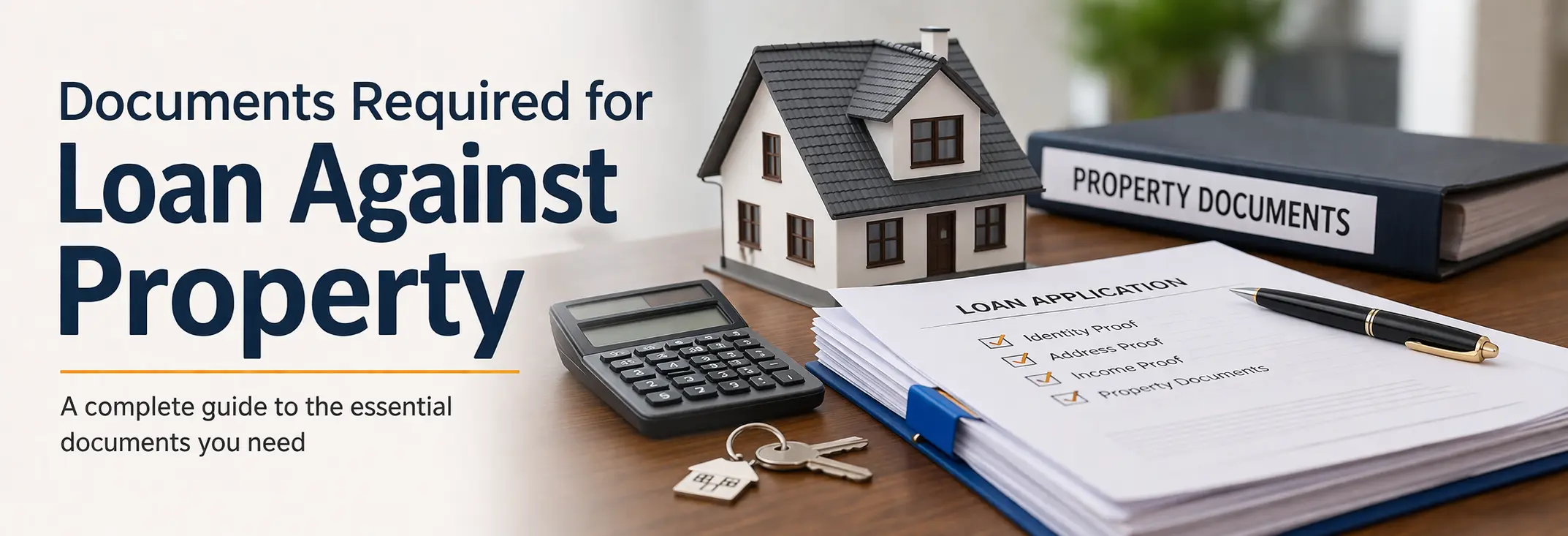
Loan Against Property (LAP) is a secured loan where borrowers pledge their residential or commercial property as collateral to get funds from banks or financial institutions. To process the loan application, lenders require several documents related to identity, income, and property ownership. Providing the correct documents helps in faster loan approval and verification.
Lenders require valid identity proof to verify the borrower’s identity. Commonly accepted documents include Aadhaar Card, PAN Card, Passport, Voter ID, or Driving License.
Address proof is required to confirm the borrower’s residential address. Documents such as Aadhaar Card, Passport, Utility Bills, or Rental Agreement are generally accepted.
Income documents help lenders evaluate the borrower’s repayment capacity. Salaried individuals usually need to submit salary slips for the last 3–6 months, bank statements, and Form 16.
Most lenders require bank statements for the last 6 to 12 months. These statements help them analyze income flow, expenses, and financial stability.
Property documents are the most important requirement for a Loan Against Property. These include property title deed, sale agreement, property tax receipts, and approved building plan.
Lenders usually conduct a property valuation to determine the current market value of the property. The loan amount offered is often based on this valuation.
Salaried applicants may need employment verification documents, while self-employed individuals must submit business registration proof, GST registration, or business financial statements.
Self-employed individuals are usually required to provide Income Tax Returns (ITR) for the last 2–3 years along with profit and loss statements.
Borrowers need to submit recent passport size photographs as part of the loan application and verification process.
The borrower must fill out the loan application form provided by the bank or NBFC with accurate personal, financial, and property details.
Submitting the correct documents is an important step when applying for a Loan Against Property. Proper documentation helps lenders verify your identity, financial status, and property ownership, which speeds up the approval process. Before applying, make sure all documents are updated and valid to avoid delays in loan processing.